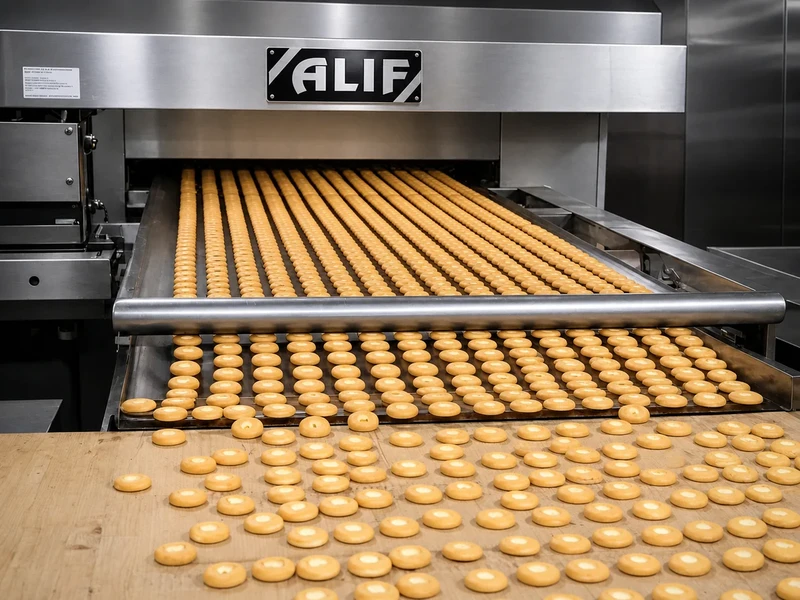
Direct fired ovens expose product to combustion gases for high-efficiency baking. Indirect fired ovens use radiant heat for cleaner, more controlled results. Here is which configuration suits your product and market.
Travelling ovens come in two fundamental configurations, direct fired and indirect fired. The difference lies in how heat reaches the product, and the choice has significant implications for product quality, fuel efficiency, and regulatory compliance. Both are available from Alif Ovens, custom-built to your belt width, zone count, and production targets.
How Direct Fired Ovens Work
In a direct fired oven, the burner flame and combustion gases enter the baking chamber and make contact with the product as it travels through on the belt. Heat transfer is fast and intense.
Direct firing delivers higher thermal efficiency because the combustion energy is used in the chamber without intermediate heat exchange losses. Pre-heat times are shorter and fuel consumption per kilogram of product is lower than equivalent indirect fired configurations.
- Best suited for: cream crackers, plain biscuits, glucose biscuits, rusks, toast
- Advantages: higher thermal efficiency, shorter pre-heat, lower fuel cost per kg
- Consideration: combustion gases are present in the baking atmosphere
How Indirect Fired Ovens Work
In an indirect fired oven, combustion takes place in a separate chamber. Heat is transferred into the baking zone by radiation or convection, the combustion gases never make contact with the product.
This provides a clean baking atmosphere, which is significant for products where hygiene requirements or food safety certifications prohibit direct combustion gas contact. Indirect ovens also allow finer independent control of top and bottom heat, which is useful for complex products with specific surface colour and crumb structure requirements.
- Best suited for: bread loaves, high-quality biscuits, dairy-based products, hygiene-sensitive markets
- Advantages: clean baking atmosphere, precise top/bottom heat control, compliance-friendly
- Consideration: slightly higher fuel consumption due to heat exchange losses
Direct vs Indirect: Summary
| Direct Fired | Indirect Fired | |
|---|---|---|
| Heat source in chamber | Yes, combustion gases present | No, radiant/convection only |
| Thermal efficiency | Higher | Slightly lower |
| Product suitability | Biscuits, rusks, cream crackers | Bread, premium biscuits, dairy products |
| Fuel cost per kg | Lower | Higher |
| Top/bottom heat control | Standard | Independent, more precise |
| Compliance consideration | Check local regulations | Generally preferred for hygiene-sensitive markets |
How to Choose
For a standard biscuit or rusk plant where combustion gas contact is not a regulatory or customer concern, direct firing is the conventional specification worldwide and the more cost-efficient choice.
For a bread plant, for products sold into markets with strict combustion gas regulations, or where your buyers require certification that product is not exposed to combustion gases, specify indirect firing.
When in doubt, confirm with your product development team and any relevant regulatory body before specifying. Retrofitting a travelling oven from one configuration to the other is not practical once built.
Alif Ovens manufactures both configurations, custom-built to belt width, length, number of zones, and fuel type. Contact our team to discuss your specific product and market requirements.
Have a question about this?
Our team is available on WhatsApp for quick questions, quotations, and technical discussions about any of our equipment.