
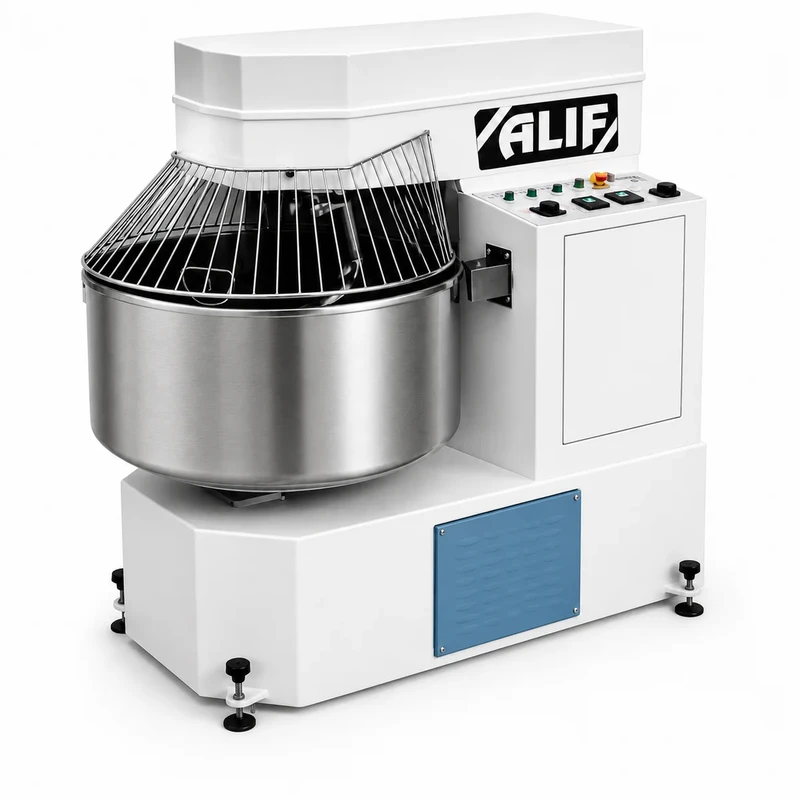
Both are essential in industrial bakeries, but they do very different jobs. Spiral mixers are built for heavy dough at scale; planetary mixers handle lighter batters, creams, and cake mixes. Here is when to use each.
Both spiral and planetary mixers are foundational to commercial bakery production, but they are engineered for different materials, different mixing actions, and different scales of operation. Using the wrong type affects dough development, batch consistency, and over time, equipment service life.
Spiral Mixers: Built for Heavy Dough
A spiral mixer has a fixed bowl and a spiral-shaped hook that rotates around its own axis while simultaneously orbiting the bowl. The bowl also rotates, ensuring the entire dough mass is worked uniformly on every revolution.
The spiral action develops gluten efficiently without generating excessive frictional heat, which is critical for bread doughs where dough temperature directly affects fermentation rate and final crumb structure. Industrial spiral mixers handle dough weights from 20 kg up to 200+ kg per batch.
- Bread doughs: white, brown, wholemeal, multigrain
- Bun, pav, and dinner roll doughs
- Rusk and toast doughs
- High-hydration doughs including ciabatta and focaccia
- Pizza bases at commercial scale
Planetary Mixers: Built for Versatility
A planetary mixer has an interchangeable attachment, dough hook, wire whisk, or flat beater, that orbits around a fixed bowl centre, similar to a planet around the sun. Different attachments enable completely different mixing actions from the same machine.
The planetary mixer's strength is versatility across a wide range of materials. The dough hook handles medium-weight doughs; the whisk aerates cream, meringue, and egg-based batters; the flat beater works cake batters, cookie dough, and soft fillings.
- Cake batters: sponge, pound cake, muffin
- Whipped cream, icing, and meringue
- Cookie and shortbread dough
- Pastry cream and soft fillings
- Light biscuit and nankhatai dough
Spiral vs Planetary: Comparison
| Spiral Mixer | Planetary Mixer | |
|---|---|---|
| Primary material | Heavy bread and rusk dough | Light batters, cream, cookies |
| Mixing action | Spiral hook in rotating bowl | Interchangeable attachments |
| Frictional heat | Low, better dough temperature control | Higher, not ideal for heat-sensitive doughs |
| Batch capacity | 20-200+ kg | 5-80 kg |
| Attachment options | Fixed hook only | Hook, whisk, flat beater |
| Typical use case | Bread, buns, rusk production | Cakes, creams, cookies, pastries |
Which Do You Need?
Most commercial bakeries operating at scale need both, a spiral mixer for dough preparation (bread, buns, rusk) and a planetary mixer for batters, cream, and lighter mixes (cakes, cookies, icing).
If you are setting up a dedicated bread or rusk line, the spiral mixer is the primary specification. Larger bowls and slower mixing speeds give you consistent dough development and temperature control across high volumes.
If you are setting up a cake or cookie line, a planetary mixer is the correct starting point. The flat beater and whisk attachments give you the aeration and emulsification control that a spiral hook cannot provide.
For mixed-product operations, discuss your full product range before specifying capacity. The right combination of bowl sizes and machine counts can significantly reduce both capital and operating cost.
Have a question about this?
Our team is available on WhatsApp for quick questions, quotations, and technical discussions about any of our equipment.