
Two of the most popular industrial ovens, but built for very different production needs. We break down the key differences in capacity, product suitability, fuel efficiency, and cost to help you choose.
When specifying a new bakery oven, the choice between a rotary rack oven and a travelling (tunnel) oven is one of the most consequential decisions an operator will make. Both are built for commercial and industrial production, but they serve different scales of operation and different product profiles. Choosing the wrong type wastes capital; choosing the right one determines the ceiling of your production capacity for years.
What Is a Rotary Rack Oven?
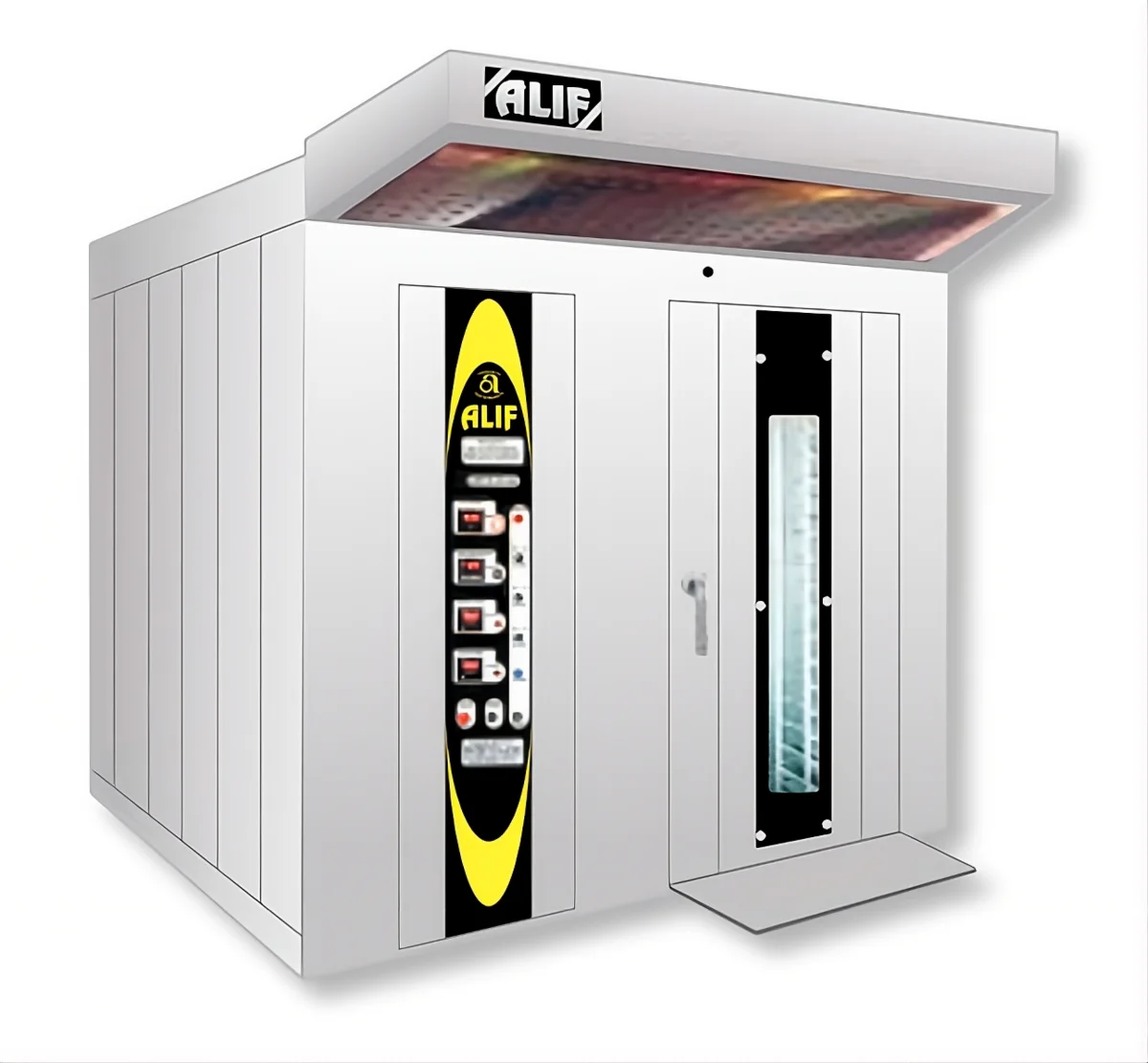
A rotary rack oven loads product onto trolley-mounted racks, typically 8 to 80 trays per trolley, which rotate inside the baking chamber for even heat distribution. Alif rotary rack ovens are available in 8 models (AO-70 through AO-220), accommodating 1 to 4 trolleys.
They are batch-process ovens: load a rack, run a baking cycle (typically 15–40 minutes depending on product), unload, and reload. The rotating mechanism ensures all trays receive uniform heat without manual tray rotation.
- Ideal for: bread loaves, buns, pav, rusks, pastries, cakes, biscuits, khari, nankhatai
- Footprint: compact, typically 2m × 2m for a single-trolley model
- Investment: accessible, suitable for commercial bakeries of all sizes
- Flexibility: high, switch between products with minimal changeover
What Is a Travelling Oven?
A travelling oven, also called a tunnel oven or continuous oven, moves product on a wire mesh or steel belt through a series of heated zones continuously. Product enters one end raw and exits the other baked, in a non-stop stream.
Travelling ovens are designed for high-volume, single-product production runs. Belt widths typically range from 800mm to 1500mm, and oven lengths from 10 to 80+ metres depending on production targets. They are available in direct and indirect fired configurations.
- Ideal for: biscuit lines, bread plants, rusk and toast lines at industrial scale
- Footprint: large, requires dedicated production floor space
- Investment: higher, typically a complete plant specification
- Flexibility: lower, each line is set up for a fixed product profile
Key Differences at a Glance
| Rotary Rack Oven | Travelling Oven | |
|---|---|---|
| Process type | Batch | Continuous |
| Best for | Multiple products, varied batches | Single product, high-volume runs |
| Footprint | Small (2m × 2m typical) | Large (10-80m length) |
| Product flexibility | High, easy product switching | Low, built for one product line |
| Capital requirement | Lower | Higher |
| Peak output (Alif) | 840 bread loaves/batch (AO-220) | Tonnes per hour |
Which Should You Choose?
If you are running a commercial bakery producing multiple product types in varying batch quantities — breads one shift, pastries the next, biscuits for a retail account — a rotary rack oven gives you the flexibility and a manageable initial investment.
If you are setting up a dedicated biscuit plant or industrial bread line with a fixed daily production target measured in hundreds of kilograms or tonnes, a travelling oven is the correct specification. You will not achieve competitive per-unit cost at that scale with batch equipment.
Many serious operations run both: a travelling oven for primary high-volume production, and one or more rotary rack ovens for smaller batches, specialty products, or overflow capacity during peak periods.
Not sure which applies to your operation? Send us your daily production target, product list, and available floor area via WhatsApp, we will give you a direct recommendation.
Have a question about this?
Our team is available on WhatsApp for quick questions, quotations, and technical discussions about any of our equipment.